
Stylus Profilometers
Description
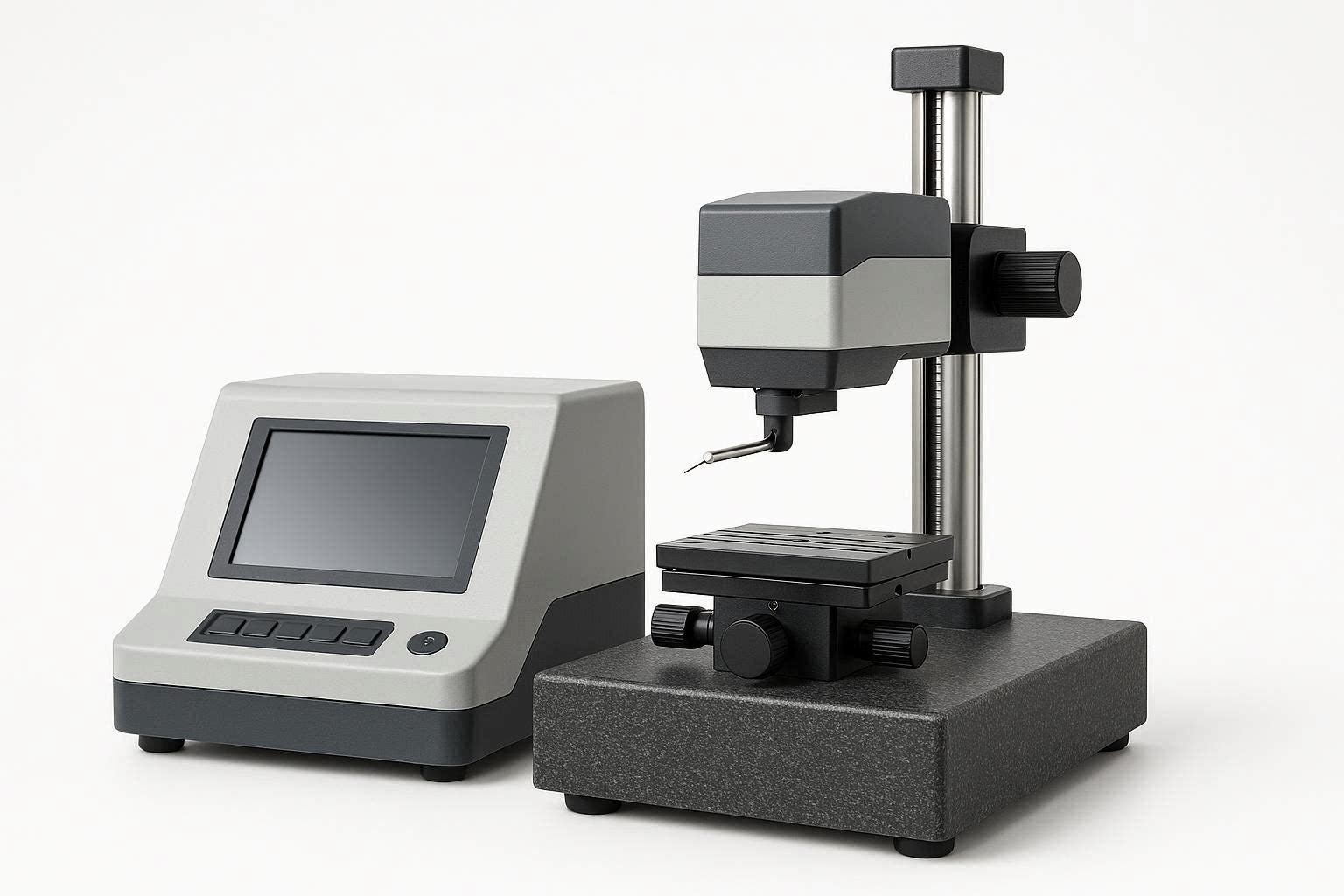
A Stylus Profilometer is a high-precision instrument used to measure the surface -topography, roughness, and profiles of various materials. It is widely employed in industries such as manufacturing, materials science, electronics, and quality control to ensure surface quality and specifications.
What is a Stylus Profilometer?
A Stylus Profilometer operates by physically dragging a fine-tipped stylus across a surface to record its vertical deviations. The stylus is mounted on a sensitive cantilever or spring system that detects surface features at the nanometer to micrometer scale. The collected data is used to generate detailed surface profile graphs, roughness parameters, and 3D surface maps.
How it works:
- The stylus moves across the surface under controlled force.
- Vertical movements of the stylus are detected by a transducer.
- The device records surface variations as a profile or roughness parameters.
- Data is processed to analyze surface quality and characteristics.
Key Features of Stylus Profilometers:
- High Accuracy & Resolution: Capable of measuring nanometer-level surface features.
- Versatile Measurement Modes: Contact profilometry, surface roughness, step height, and more.
- 3D Surface Mapping: Some models offer surface topography imaging.
- User-Friendly Interface: Software for data analysis and report generation.
- Robust & Reliable: Suitable for a wide range of materials, including metals, plastics, ceramics, and coatings.
Common Applications of Stylus Profilometers:
- Surface Roughness Testing: Ensuring components meet specified surface finish standards.
- Material Characterization: Analyzing surface features for research and development.
- Quality Control: Monitoring manufacturing processes for consistency.
- Coating Thickness Measurement: Evaluating surface coatings and thin films.
- Microfabrication: Profiling small features and steps on micro-scale devices.
Advantages of Stylus Profilometers:
- Precise and Repeatable Measurements: Ideal for critical surface quality evaluations.
- Non-Destructive: Does not damage the surface being measured.
- Broad Material Compatibility: Suitable for diverse surface types and textures.
- Cost-Effective: Reliable for both research labs and industrial applications.
Key Value Propositions of Stylus Profilometers
- Metrology Precision: Delivers sub-angstrom vertical resolution with a low-force constant-contact mode to prevent damage to fragile low-k dielectrics.
- Cleanroom Integrity: Fully certified for ISO Class 1 environments, featuring integrated ULPA filtration and ESD-safe materials to minimize contamination.
- Operational Reliability: Engineered for high MTBF (> 5,000 hours) with a modular design that facilitates rapid field-serviceable component swaps.
- Lower Cost of Ownership (COO): High-speed scanning algorithms and long-life diamond styli significantly reduce the per-wafer measurement cost.
- Automation & Connectivity: Full SECS/GEM interface support for seamless integration into Fab Host/MES systems and automated recipe management.
Technical Deep-Dive of Stylus Profilometers
- The core technology utilizes a high-precision LVDT (Linear Variable Differential Transformer) sensor coupled with a pivot-arm stylus assembly. This allows for a massive dynamic range, capable of measuring nanometer-scale roughness and millimeter-scale step heights in a single scan.
- Material Compatibility: Optimized for hard thin films (SiN, SiO2), metals (Cu, Al), and soft polymers/photoresists using adjustable stylus force (0.03mg to 15mg).
- Wafer Handling: Supports standard SEMI-spec 200mm and 300mm wafers. High-precision vacuum chucks ensure flatness during scanning, with optional edge-grip handling for double-sided processed wafers.
- Technical Drawings: [Placeholder: Request CAD Previews for Facility Integration].
Buyer’s Guide / Decision Logic
Selecting the right profilometer depends on three critical pillars:
- Thermal Budget & Environment: For high-temperature post-anneal measurements, ensure the system is equipped with a thermal-isolated enclosure to prevent drift.
- Automation Level: Choose a manual load system for lab-based R&D; however, for HVM (High Volume Manufacturing), an integrated EFEM (Equipment Front End Module) with dual FOUP loaders is mandatory for throughput.
- Stylus Geometry: Match the stylus tip radius (e.g., 2μm vs. 0.1μm) to your smallest feature size to avoid aspect-ratio-driven measurement artifacts in deep trenches or vias.
Technical FAQ
Q: How does the system handle SECS/GEM integration?
A: All Ultra-series models come pre-configured with a SEMI E5/E30 compliant interface, allowing the Fab Host to trigger recipes and collect metrology data in real-time.
Q: What is the typical MTBF for the stylus assembly?
A: Under standard HVM conditions, the stylus assembly is rated for >1 million scan-meters. We recommend preventative calibration every 500 operating hours.
Q: Does the tool meet SEMI S2/S8 safety standards?
A: Yes, the system is fully certified for SEMI S2 (Safety Guidelines) and S8 (Ergonomics) to ensure seamless installation in international tier-1 fabs.
Q: Can it measure high-aspect-ratio trenches?
A: Using our specialized High-Aspect-Ratio (HAR) styli, the system can characterize trenches with ratios up to 10:1, depending on the required depth.
Q: What is the installation lead time?
A: Standard configurations ship within 12–16 weeks. Site preparation (vibration isolation and UHP air requirements) should begin 4 weeks prior to delivery.
In the era of rapid node shrinking and complex 3D NAND architectures, precise metrology is the cornerstone of yield optimization. Our stylus profilometers provide the critical sub-nanometer vertical resolution required to monitor film thickness, step heights, and stress in advanced wafer processing. By integrating high-throughput automation with SEMI-compliant safety standards, these tools eliminate measurement bottlenecks while ensuring stable process control for high-volume semiconductor fabrication.
Interactive Selection Table: System Configurations
This table outlines the primary configurations designed to scale from R&D environments to full-scale 300mm production fabs.
| Model No. | Throughput (WPH) | Process Uniformity (1σ) | Footprint (mm) | Primary Application |
|---|---|---|---|---|
| SP-200X Core | < 15 (Manual Load) | < 0.5 nm | 850 x 700 | R&D / Failure Analysis |
| SP-300 Plus | 45 - 60 | < 0.2 nm | 1200 x 1100 | Power Semi / MEMS Production |
| SP-300 Ultra | > 100 (Dual EFEM) | < 0.1 nm | 1800 x 1400 | Advanced Logic / Foundry |
| SP-Flex 3D | 30 - 45 | < 0.3 nm | 1300 x 1100 | Advanced Packaging / TSV |
Order Form
About Semiconductor Electronics
SEMI EL project is a global supplier of materials, equipment, spare parts and supplies for the semiconductor industry.
Get In Touch
Email: info@semi-el.com